

Affiliate Disclosure
Plumber Guide Guys is a participant in the Amazon Services LLC Associates Program, an affiliate advertising program designed to provide a means for sites to earn advertising fees by advertising and linking to Amazon.
When Was Indoor Plumbing Common in American Homes? Did you know that before 1850, less than 5% of American homes had indoor plumbing? The history of indoor plumbing in the United States is a story of big changes. It shows how technology and society evolved together, changing how people lived.
Indoor plumbing became common in American homes over many years. It started with simple water systems in cities and grew to include homes everywhere. This change improved personal hygiene, public health, and daily life for many.
Looking into when indoor plumbing became common is interesting. It shows how engineering, city growth, and society moved forward together. Each year brought new improvements, making water access in homes a basic need.
Key Takeaways
- Indoor plumbing emerged as a critical infrastructure in mid-19th century America
- Urban areas pioneered early plumbing technology
- Technological advancements drove widespread residential adoption
- Public health improvements were closely linked to plumbing development
- Economic factors significantly influenced plumbing installation rates
Table of Contents
The Early Origins of Indoor Plumbing in America
The start of indoor plumbing in the U.S. was marked by big steps forward. These changes made it easier for people to get and use water. Before these systems, managing water was a big problem that needed smart fixes and new tech.
Old civilizations helped a lot in building early water systems. Their work inspired American engineers to make better water systems.
Roots of Water Infrastructure
At first, early American homes used simple ways to get water:
- Wells dug near homes
- Rainwater collection systems
- Nearby rivers and streams
First American Plumbing Installations
The first big step in indoor plumbing was in big cities. Rich families started putting in basic water pipes and drainage. This was the start of plumbing becoming common.
The Croton Aqueduct: A Turning Point
In 1842, the Croton Aqueduct changed New York City’s water system. It brought clean water from upstate, making cities healthier and cleaner.
This success showed the power of big water systems. It made other cities want to do the same, speeding up plumbing’s growth.
Evolution of Indoor Plumbing from 1840s to 1900s
The Victorian era was a big change for plumbing in American homes. In the mid-1800s, cities saw big improvements in sanitation. These changes changed how homes were built.
Between 1840 and 1900, plumbing got a lot better. Some important changes were:
- Introduction of indoor water supply systems
- Development of advanced drainage mechanisms
- Implementation of municipal water regulations
In the 1860s, tall buildings used simple water systems. Yard hydrants were the main water source. Sanitation was basic, with privy vaults in backyards.
| Decade | Plumbing Characteristics | Urban Development |
|---|---|---|
| 1840s | Rudimentary water systems | Limited municipal infrastructure |
| 1870s | Venting systems introduced | Growing urban sanitation codes |
| 1900s | Mandatory indoor toilet facilities | Comprehensive plumbing regulations |
By the early 1900s, big cities had to make big changes. Plumbing codes said every unit had to have a toilet. This was a big step towards better sanitation.
The Victorian era was more than just new technology. It was a health revolution. It changed how Americans lived.
When Was Indoor Plumbing Common in American Households
The journey of indoor plumbing in American homes was slow and uneven. It changed urban sanitation history in the mid-20th century. The adoption rates varied a lot across different regions and income levels. This created a complex picture of home development.
To understand indoor plumbing’s spread, we need to look at several factors. These factors influenced its adoption across the United States.
Adoption Rates by Decade
The growth of indoor plumbing was slow but marked by key milestones:
- 1940: Nearly half of American homes lacked complete plumbing facilities
- 1950: Urban areas saw rapid infrastructure improvements
- 1960: Over 25% of houses in 16 states didn’t have full plumbing
Urban vs Rural Implementation
Urban sanitation history shows big differences between cities and rural areas. Cities adopted indoor plumbing faster because of:
- More infrastructure investments
- Higher population density
- Advanced municipal planning
Economic Factors Affecting Installation
The cost of installing indoor plumbing was a big barrier for many. The ability to modernize homes depended a lot on income. Lower-income families often had to wait much longer for basic plumbing.
By looking at these historical challenges, we can see how plumbing became common in American homes.
The Development of Modern Bathroom Fixtures
The journey of indoor toilets in homes changed a lot in the late 19th and early 20th centuries. Your bathroom today is far from the old days. New technologies made a big difference in how we keep clean and healthy.
The start of modern plumbing came with big changes in design and function. Inventors and engineers worked hard to make bathrooms better and more efficient.
- 1596: First semi-flushing toilet developed for British royalty
- 1870s: Water heating coils added to coal-burning stoves
- 1890s: Gas utility services enabled automatic water heaters
Bathroom fixtures changed fast, showing what people needed and what was possible. Makers started making designs that were easier to use and kept things clean.
| Decade | Key Plumbing Innovation |
|---|---|
| 1870s | Water heating technology |
| 1890s | Automatic water heaters |
| 1900s | Standardized bathroom fixtures |
By the early 1900s, indoor plumbing was no longer a luxury but a standard in American homes. Your bathroom is now a place of modern comfort, showing a lot of progress in technology.
Public Health and Sanitation Revolution
The early 20th century saw a big change in urban sanitation in the United States. Indoor plumbing played a key role in improving public health. It helped cut down on deadly diseases that used to spread fast in cities.
Pioneering efforts in urban sanitation history made a big difference. They brought in new plumbing systems that improved public health. Some important developments were:
- Improved water filtration techniques
- Advanced waste management systems
- Standardized hygiene infrastructure
Disease Prevention Through Better Plumbing
Modern plumbing systems were a big help in fighting diseases. Cholera, typhoid, and dysentery rates went down a lot. This was because of better water and waste systems. The change in plumbing helped people see health in a new way.
Government Regulations and Standards
In 1920, Herbert Hoover, then Secretary of Commerce, started the National Bureau of Standards’ Materials and Structures Division. Dr. Roy Hunter’s work was key in creating modern plumbing codes. These codes made water systems safer and more reliable everywhere.
Impact on Urban Development
Advanced plumbing changed American cities for the better. Cities became healthier and more pleasant places to live. Clean water and good waste systems became common. Neighborhoods were completely transformed by these new technologies.
Indoor Plumbing Statistics from 1920 to 1950
The early 20th century saw a big change in American homes. In 1920, indoor plumbing was a rare luxury. Only a small number of homes had it.
Looking back at when indoor plumbing became common shows how far we’ve come:
- In 1920, just 1% of U.S. homes had full indoor plumbing
- By 1940, nearly 50% of houses lacked essential plumbing features
- Urban areas saw faster indoor plumbing adoption compared to rural regions
The rich and those living in cities were the first to get indoor plumbing. But, it took longer for rural areas and poorer neighborhoods to catch up. They faced challenges like limited access to water and poor infrastructure.
Thanks to government efforts and better building standards, things changed. By 1950, most homes had moved from outhouses to modern bathrooms. This was a big step forward for health and living standards.
“The evolution of indoor plumbing represents more than just technological progress—it symbolizes America’s rapid modernization during the early 20th century.”
The Post-War Plumbing Boom
The years right after World War II were a big change for plumbing in American homes. A lot of new buildings and tech advancements changed how plumbing worked in homes. Soon, almost every home in the U.S. had modern plumbing.
The economy grew a lot after the war, leading to big changes in homes. Families started using new tech that made life easier and more comfortable. This changed how people lived at home.
New Construction Standards
New rules for building homes came out after the war. These rules made sure new homes had good plumbing. They included:
- Mandatory indoor bathroom installations
- Enhanced water pressure requirements
- Standardized pipe materials and connections
- Improved drainage and waste management systems
Suburban Home Development
As suburbs grew, plumbing became more common. New areas needed good water and sanitation. This led to more tech and plumbing in homes.
Modern Convenience Features
People loved new plumbing features that made life better:
- Automatic water heaters
- Garbage disposals
- Multi-fixture bathroom designs
- Advanced water filtration systems
By 1950, less than 5% of American households lacked complete plumbing facilities, showing how far plumbing technology had come.
Regional Differences in Indoor Plumbing Adoption
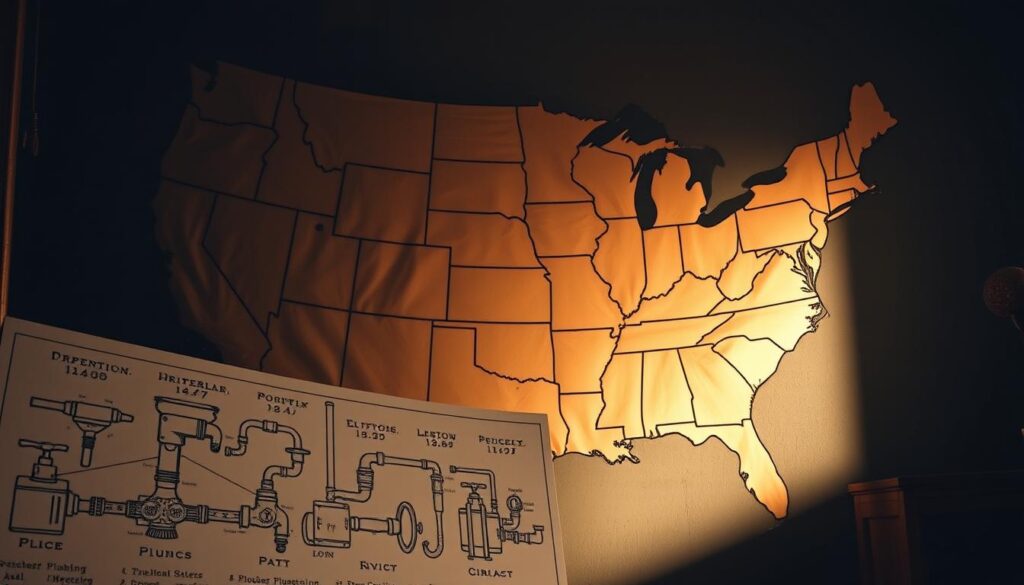
The history of indoor plumbing in the US is complex. By 1960, big differences in plumbing adoption rates were seen across the country. Some states were slow to update their homes with modern plumbing.
In the South, indoor plumbing faced unique challenges. The introduction of air conditioning in the 1950s and 1960s changed home building. This led to faster adoption of indoor plumbing in these areas.
- By 1960, over 25% of houses in 16 states lacked complete plumbing facilities
- Economic conditions played a big role in plumbing infrastructure
- Climate also affected housing and sanitation development
Rural areas were behind cities in getting indoor plumbing. Money, local rules, and infrastructure issues caused big differences. The Midwest and Northeast adopted plumbing faster than the South and West.
Looking at these differences helps us understand how American homes and sanitation evolved. Your home’s plumbing was shaped by where you lived in the mid-20th century.
Evolution of Plumbing Materials and Technology
The indoor plumbing world has seen big changes in the 20th century. Homeowners wanted better and safer water systems. So, makers created new materials and heating tech that changed homes.
In the 1940s, material limits led to new ideas in plumbing. Makers moved from old metals to new, game-changing options. These changes changed how water flows in homes.
Pipe Material Transformation
Going from dangerous lead pipes to safer ones was a big step. Important changes included:
- Switching from lead to copper pipes
- Starting to use polyvinyl chloride (PVC) pipes
- Creating cross-linked polyethylene (PEX) piping
Water Heating Innovations
Water heating tech saw huge improvements, moving from old coal to new, energy-saving ways. Homeowners got:
- Electric water heaters
- Gas-powered systems
- Tankless water heating tech
These changes didn’t just make water better. They also made homes more comfortable and efficient.
Conclusion
The history of indoor plumbing is a story of amazing progress. It changed American homes from simple to modern. This journey shows how society and technology grew together in the 20th century.
Indoor plumbing’s history is not just about pipes and fixtures. It shows how homes, health, and life quality improved. The move from outhouses to modern bathrooms is a sign of human creativity and growth.
Reflecting on indoor plumbing, we see it as a symbol of human advancement. It went from rare in cities to common in homes. This shows how new tech makes our daily lives better.
Plumbing technology is always getting better. We’re seeing smart water systems, ways to save water, and new materials. Your home’s plumbing is a story of American innovation.