

Affiliate Disclosure
Plumber Guide Guys is a participant in the Amazon Services LLC Associates Program, an affiliate advertising program designed to provide a means for sites to earn advertising fees by advertising and linking to Amazon.
When Did Indoor Plumbing Become Common in America? In 1940, a shocking fact was revealed: nearly half of American homes didn’t have basic plumbing like hot water or flush toilets. The history of indoor plumbing in the US is a story of big changes in technology and health.
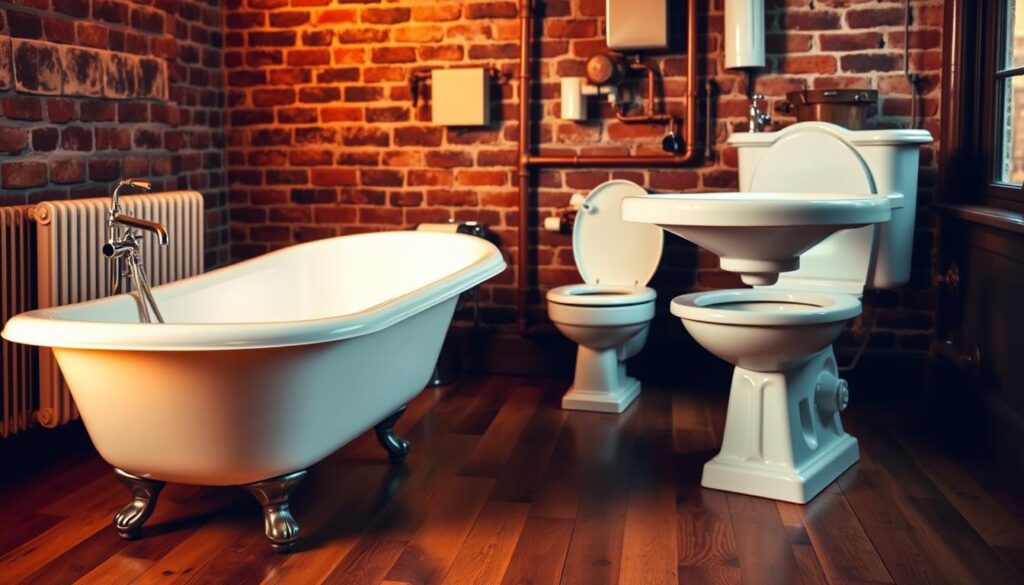
When did indoor plumbing become common in America? This question leads to a story of growth. From simple water systems to today’s complex plumbing, it changed how Americans lived and kept clean.
The history of indoor plumbing in the US shows big changes in society. What we now see as basic was once a big deal. It shows how technology changed the world in the 19th and 20th centuries.
Key Takeaways
- In 1940, less than half of American homes had complete plumbing
- Plumbing development was closely linked to public health improvements
- Technological innovations dramatically transformed household infrastructure
- Urban areas adopted plumbing systems faster than rural regions
- Plumbing advancements reflect broader societal technological progress
Table of Contents
The Ancient Origins of Plumbing Systems
Plumbing has a long history, starting thousands of years ago. It laid the foundation for the advanced urban sanitation systems in America today. Ancient people developed smart ways to manage water, shaping our modern infrastructure.
The early days of plumbing in America were filled with groundbreaking innovations. These changes were key to the growth of human societies. Water management was essential for survival and building cities.
Early Mesopotamian Water Systems
Mesopotamian engineers were true pioneers in water technology. They built impressive canal systems that showed off their engineering skills:
- Developed complex irrigation networks
- Constructed underground clay pipe systems
- Created drainage channels in urban settlements
Roman Plumbing Revolution
The Roman Empire took water infrastructure to new heights. Their engineering skills were unmatched:
| Roman Innovation | Key Feature |
|---|---|
| Aqueducts | Transported water over long distances |
| Lead Pipes | Enabled sophisticated water distribution |
| Public Bathhouses | Advanced communal sanitation practices |
Medieval Water Management
In medieval times, plumbing became more focused on local needs. Communities built simple water systems. These systems kept the knowledge alive, preparing the way for America’s urban sanitation advancements.
The Birth of Modern Plumbing in America
The change in indoor toilets in the United States started with a big engineering achievement. The Croton Aqueduct, finished in 1842, was a key moment in indoor toilets history. It brought pressurized water to New York City, changing urban life.
Before this, getting water was hard and not reliable. The Croton Aqueduct fixed these problems by giving:
- Reliable water pressure for fire hydrants
- Consistent water supply for urban residents
- Foundation for modern plumbing systems
“The Croton Aqueduct was not just a water system, but a blueprint for urban sanitation and public health.” – Water Engineering Historian
Soon, cities saw the value of pressurized water systems. Across the United States, cities started building similar systems. This changed how people used water at home and in public places.
| Year | Plumbing Development | Impact |
|---|---|---|
| 1842 | Croton Aqueduct Completed | Introduced Pressurized Water |
| 1850-1870 | Urban Water System Expansions | Improved City Sanitation |
The success of the Croton Aqueduct led to a big change in water systems across the country. It paved the way for modern plumbing, greatly improving health and living standards in cities.
Early American Plumbing Developments (1800-1850)
The early 19th century was a time of big change for water systems in America. Cities grew and new technologies came along. These changes made it easier for people to get and use water every day.
Only rich families had indoor plumbing at first. But cities were working on new ways to bring water to homes. They built systems that would change how we get water today.
- Establishing first municipal water supply networks
- Developing underground pipe systems
- Creating public water distribution points
First Public Water Systems
New York City was a leader in water systems. By the 1830s, cities started building big water systems. These systems brought clean water to many people.
The Croton Aqueduct Impact
The Croton Aqueduct was a big deal for water systems. This project brought water from the Croton River to New York City. It showed how big water projects could work.
Early Residential Applications
Rich homes started using indoor plumbing early on. They had simple water systems with basic fixtures. These early systems were the start of modern plumbing, but they had many problems.
The journey of water systems in America was just beginning, with innovation and necessity driving remarkable transformations.
When Did Indoor Plumbing Become Common in America
The history of plumbing in the 19th century in America is quite interesting. In the early 1900s, only a few Americans had indoor plumbing. Census data shows how slow the adoption of modern water systems was in the United States.
Over time, plumbing technology improved slowly. By 1920, only 1% of U.S. homes had both indoor plumbing and electricity. Cities were the first to get these modern amenities.
- 1900-1920: Limited indoor plumbing in major cities
- 1920-1940: Gradual expansion of water infrastructure
- 1940-1950: Significant increase in household plumbing
Several factors helped plumbing become more common:
- Improvements in making pipes
- Better urban infrastructure
- More awareness of public health
- Growing economy
| Decade | Homes with Indoor Plumbing | Urban Adoption Rate |
|---|---|---|
| 1900 | 10% | 25% |
| 1920 | 20% | 40% |
| 1940 | 50% | 75% |
By 1940, almost half of American homes didn’t have complete indoor plumbing. Rural areas were much slower to adopt plumbing than cities. This created a big gap in infrastructure across the country.
The Evolution of American Bathroom Fixtures
The way Americans cleaned up changed a lot with indoor plumbing. New tech made bathroom fixtures better and easier to use.
When did indoor plumbing become common in America? The late 19th and early 20th centuries were key. Homeowners saw big changes in their bathrooms thanks to new inventions.
Toilet Technology Advancements
Toilets went through big changes. Some key updates were:
- Improved flushing mechanisms
- Ceramic materials replacing old designs
- Better sanitation features
Water Heater Development
Water heating tech changed home comfort a lot. Important steps were:
| Year | Innovation | Impact |
|---|---|---|
| 1870s | Water heating coils in coal stoves | First home water heating method |
| 1890s | Gas utility services | Automatic water heaters appeared |
| 1900s | Plumbed hot water systems | Got popular in homes |
Shower and Bathtub Innovation
Bathing got better with new tech. Porcelain-enameled cast iron tubs and standard showers became common. This made bathing easier and more fun.
These changes greatly improved life for Americans. They set new standards for comfort and cleanliness in bathrooms.
Urban Sanitation Revolution (1850-1900)
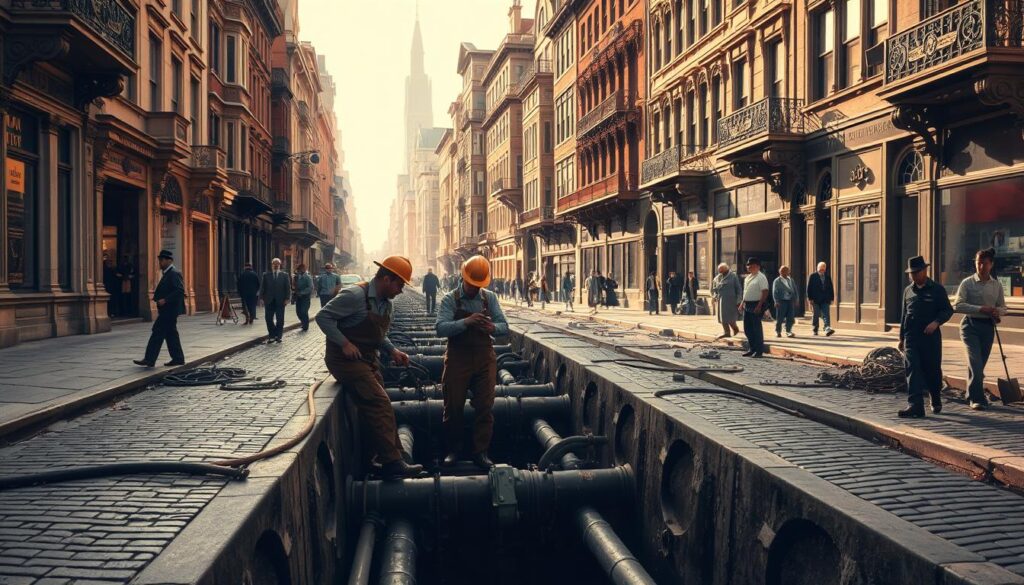
The second half of the 19th century saw a big change in America’s cities. Cities grew fast but had no good way to handle waste. This was a big problem for public health and city planning.
Chicago was a leader in this change. In 1855, it started the Board of Sewerage Commissioners. This led to a sewer system that other cities looked up to.
- Improved waste disposal methods
- Development of underground drainage networks
- Reduction of waterborne diseases
- Enhanced urban living conditions
“The health of a city depends on its ability to manage water and waste effectively.” – Public Health Pioneer, 1870
Cities started spending a lot on better infrastructure. New engineering helped create better water systems. This made cities healthier places to live.
| City | Sewer System Established | Impact on Public Health |
|---|---|---|
| Chicago | 1855 | Significant disease reduction |
| New York | 1860 | Improved sanitation standards |
| Boston | 1870 | Decreased waterborne illnesses |
Learning about urban sanitation in America shows a key time of change. These changes helped create the modern health systems we have today. They changed how cities handle water and waste.
The Role of Plumbing Codes and Regulations
The history of indoor plumbing in the US saw a big change with rules and standards. Plumbing codes became key to keeping people safe, water clean, and buildings reliable in the early 1900s.
Government agencies were vital in setting rules for indoor plumbing. The National Bureau of Standards was a major player in creating these important guidelines.
National Bureau of Standards Contributions
Herbert Hoover, as Secretary of Commerce, made big changes by starting the Materials and Structures Division. Dr. Roy Hunter led important studies that changed plumbing standards.
- Developed detailed research methods
- Did thorough checks on plumbing systems
- Set up standard installation rules
State and Local Regulatory Frameworks
Local governments started using their own plumbing codes to tackle local issues. These rules made sure quality and safety were the same everywhere.
| Regulatory Level | Key Responsibilities | Implementation Year |
|---|---|---|
| National Standards | Comprehensive Guidelines | 1920-1930 |
| State Regulations | Regional Adaptation | 1930-1950 |
| Local Codes | Community-Specific Requirements | 1940-1960 |
These rules helped indoor plumbing spread fast in cities and towns. They greatly improved health and building standards across America.
Rural vs Urban Plumbing Adoption Rates
The history of water supply in the U.S. shows a big difference between cities and rural areas. By 1960, there was a big gap in plumbing access across the country.
Rural areas had a hard time getting modern plumbing. They faced money problems, were far from cities, and had poor infrastructure. These issues made it hard for them to get indoor plumbing.
- By 1940, most cities had good plumbing systems
- Rural places were behind by almost 20 years
- Money spent on plumbing was very different in cities and rural areas
Important things that affected plumbing adoption included:
- Local money situation
- How close to city water systems they were
- Development of community infrastructure
- Help from the federal and state governments
The Federal Housing Administration was key in speeding up water supply growth. They offered incentives and rules that helped improve plumbing across the country.
By 1960, over 25% of houses in 16 states were without full plumbing, showing a big gap between rural and urban areas.
Knowing about these historical patterns helps us see how much the U.S. water infrastructure changed in the mid-20th century.
The Impact of Indoor Plumbing on Public Health

Indoor plumbing changed public health in America for the better. It cut down on deadly waterborne diseases. This big change in urban sanitation and community health came when indoor plumbing became common.
Before modern plumbing, cities like Chicago faced huge disease outbreaks. In 1849, a cholera epidemic killed 678 people, which was 2.9% of the city’s population. With better water and sewage systems, cities could greatly improve health.
- Reduced transmission of waterborne illnesses
- Improved personal and community hygiene
- Decreased infant mortality rates
- Enhanced overall public health standards
Indoor plumbing brought big changes in disease prevention in America. Clean water and waste removal became key to public health. Cities started investing in plumbing, seeing its life-saving value.
“Clean water is the foundation of public health.” – Public Health Pioneer
By the early 20th century, indoor plumbing was common in urban homes. It changed personal hygiene and community health. This approach to water management greatly reduced epidemics that once devastated populations.
Modern Plumbing Infrastructure Development
The American plumbing timeline has seen big changes in bathroom design. New technologies have changed how we build and keep plumbing systems in the U.S.
In the mid-20th century, new materials changed plumbing. World War II made old metals hard to find, so new ones were needed.
Revolutionary Materials in Plumbing
Plumbing materials got a lot better, making systems last longer and work better:
- Cast iron became a strong choice for pipes
- Plastic made pipes lighter and less prone to rust
- PVC and ABS plastics are now common in homes and businesses
Advanced Installation Techniques
New ways to install plumbing have made systems better and more reliable:
- Computer-aided design (CAD) helps plan systems
- Trenchless pipe replacement is a new method
- Improved welding and connections are used
“Innovation distinguishes between a leader and a follower in plumbing infrastructure.” – Anonymous Plumbing Engineer
| Material | Introduction Year | Key Advantages |
|---|---|---|
| Cast Iron Pipes | 1940s | High durability, noise reduction |
| PVC Pipes | 1950s | Lightweight, corrosion-resistant |
| Cross-Linked Polyethylene | 1960s | Flexible, temperature-resistant |
These changes are making plumbing better for the future. They ensure systems are sustainable, efficient, and reliable for years to come.
The Future of American Plumbing Systems
The water systems in American homes are changing fast. New technologies and smart ideas are leading the way. Your bathroom is about to get a big upgrade, thanks to smart tech and green living.
New plumbing systems are changing how we use water. These systems are more efficient and smart. They help us manage water better at home.
- Smart water monitoring systems that detect leaks in real-time
- Eco-friendly fixtures reducing water consumption
- Advanced filtration technologies improving water quality
- Integrated digital management platforms for home water systems
Artificial intelligence and IoT technologies are revolutionizing water management. They let homeowners track water use, stop leaks, and save water like never before.
The future of plumbing is all about being green and smart. Water recycling and energy-saving tech are becoming common. Cities and companies are spending big to update old systems and protect the environment.
“The next decade will redefine how we think about water in our homes” – Water Technology Institute
Your bathroom will soon have smart features like predictive maintenance and touchless faucets. These new technologies will make old plumbing seem old-fashioned.
Conclusion
The history of indoor plumbing in the United States is a story of amazing progress. It changed American life in big ways. When indoor plumbing became common, it was a key moment for public health and homes.
From the early 19th century innovations to the mid-20th century, it changed how we live and keep clean. It made a huge difference in how Americans lived, worked, and took care of their health.
By 2000, almost every American home had modern plumbing. This was a big change from the 1800s. The progress in plumbing showed how far we’ve come, from luxury in rich homes to a basic need everywhere.
Technological advances in materials, design, and installation helped make plumbing common. This change was not just about technology; it was a big social shift too.
It brought better sanitation, less disease, and a better life. As we move forward, we’ll see even better water systems thanks to new tech and infrastructure.
The story of indoor plumbing in America shows our creativity and desire to make life better. It’s a story of human ingenuity and progress.