

Affiliate Disclosure
Plumber Guide Guys is a participant in the Amazon Services LLC Associates Program, an affiliate advertising program designed to provide a means for sites to earn advertising fees by advertising and linking to Amazon.
What Does It Take to Become a Plumber? Are you wondering what it takes to be a top plumber in today’s job market? Plumbing is more than just fixing pipes and unclogging drains. It’s a dynamic career that requires skill, problem-solving, and hands-on experience.

When you explore the plumbing career path, you see a profession that’s both technical and practical. As a plumber, you’ll be key in keeping homes, businesses, and communities running smoothly across the U.S.
To become a plumber, you need to understand the training, skills, and dedication required. The path includes technical education and apprenticeships. It’s a challenging but rewarding journey.
Key Takeaways
- Plumbing is a skilled trade with excellent career opportunities
- Requires a combination of classroom learning and practical experience
- Typically takes 4-5 years to complete full professional training
- Offers competitive salaries and job security
- Provides multiple career advancement paths
- Involves diverse work environments and specializations
- Requires continuous learning and skill development
Table of Contents
Understanding the Plumbing Profession and Career Overview
Plumbing is a vital trade that offers great career paths for those who enjoy technical skills and hands-on work. To become a plumber, you need more than just technical knowledge. You also need physical stamina, problem-solving skills, and a drive to keep learning.
Professional plumbers are key to keeping our infrastructure running smoothly in homes, businesses, and factories. Your job will involve more than just fixing pipes.
Core Responsibilities of Professional Plumbers
As a plumber, you’ll handle a wide range of tasks that need precision and technical know-how:
- Reading and understanding complex blueprints
- Installing water and drainage systems
- Fixing and keeping plumbing fixtures in good shape
- Checking pipes for leaks and making sure they work right
- Following local building codes
Work Environment and Physical Demands
The plumbing job requires being physically fit and able to adapt. You’ll work in different places, from new construction sites to small homes. You can expect to:
- Lift heavy items that weigh up to 50 pounds
- Work in tight and sometimes hard-to-reach spots
- Stand for long periods
- Deal with tough work conditions
Job Titles and Career Specializations
Your education in plumbing will lead to many career paths, including:
- Apprentice Plumber
- Residential Construction Plumber
- Commercial Plumbing Specialist
- Maintenance Plumber
- Plumbing System Designer
Each speciality brings its own challenges and chances for growth in the plumbing field.
Educational Requirements and High School Preparation
Starting your plumber career needs a strong educational base. You must finish high school or get a GED. This step is key to get into apprenticeships and learn plumbing skills.
If you’re in high school and want to be a plumber, focus on important subjects. These include:
- Mathematics (algebra and geometry)
- Physics and physical sciences
- Technical drawing or blueprint reading
- Vocational or shop classes
Plumber education focuses on practical skills and technical knowledge. Doing well in math and science helps a lot. Your high school classes are a big step towards a plumbing career.
| Subject Area | Relevance to Plumbing | Skills Developed |
|---|---|---|
| Mathematics | Calculating measurements and angles | Precision and spatial reasoning |
| Physics | Understanding water pressure | Technical problem-solving |
| Chemistry | Material interactions | Scientific understanding of pipe systems |
Pro tip: If your high school has vocational or technical classes, take them. They offer real-world experience that helps in apprenticeships.
Not finishing high school? There are other ways. GED programs and prep courses can help you meet plumber education needs. They prepare you for a career in the trades.
What Does It Take to Become a Plumber: Essential Qualifications
To become a plumber, you need more than just a job interest. You must understand the key requirements for success in this trade.
Before you start your plumbing career, you must meet several important criteria. These show you’re ready for the challenges of this profession.
Age and Health Requirements
The path to becoming a plumber starts with age and health standards. Most apprenticeship programs require:
- Being at least 18 years old
- Being in excellent physical condition
- Being able to do physically demanding tasks
Your physical fitness is key in becoming a plumber. The job needs strength, flexibility, and endurance. You must be able to:
- Lift heavy materials up to 50 pounds
- Work in cramped or awkward positions
- Stand for long periods
- Navigate tight spaces and challenging work environments
Academic Prerequisites and Entrance Exams
Academic preparation is vital for a plumber’s success. Most programs require:
- A high school diploma or equivalent GED
- Basic math skills
- Strong reading comprehension
- Mechanical aptitude
Entrance exams test your math, problem-solving, and technical skills. Preparing for these exams can boost your chances of getting into a good apprenticeship program.
Pro tip: Consider taking preparatory courses or practice exams to enhance your academic readiness for plumbing career entry requirements.
Plumbing Apprenticeship Requirements and Training Structure
Starting your plumbing career means understanding the key apprenticeship requirements. These programs turn you into a skilled plumber through training and hands-on work.
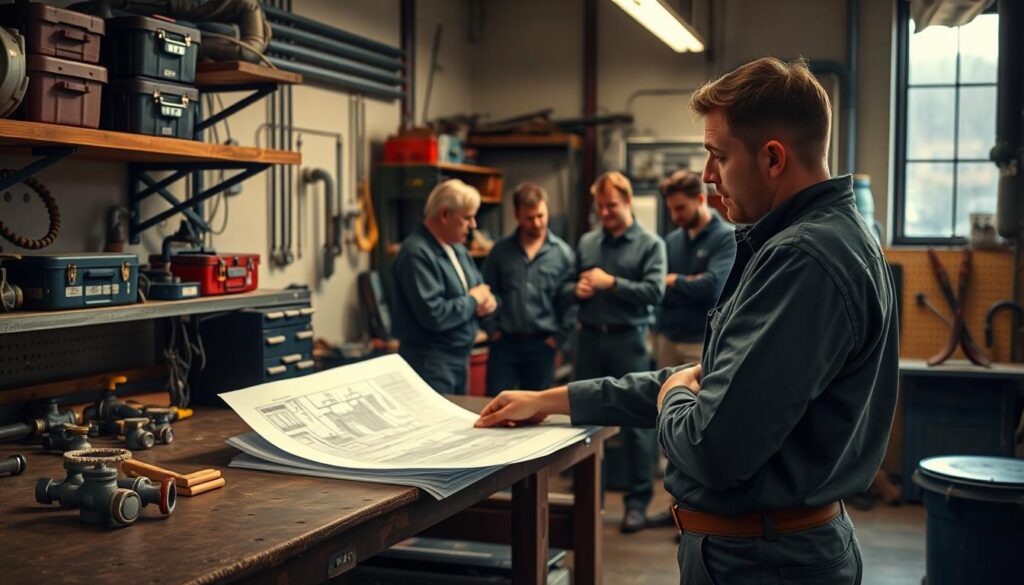
- Working directly with local plumbing contractors
- Joining union-sponsored apprenticeship programs
Finding an Employer or Union Sponsorship
Finding a sponsor for your plumbing apprenticeship requires networking. Look for sponsors in different places:
- Contact local plumbing unions like United Association (UA)
- Reach out to regional plumbing contractors
- Use state apprenticeship agency resources
- Go to trade school job fairs
“The key to a successful plumbing apprenticeship is persistence and demonstrating genuine enthusiasm for the trade.” – Professional Plumbers Association
On-the-Job Training Hours and Workplace Experience
Plumbing apprenticeships last 4-5 years. You’ll get 8,000-10,000 hours of work experience under journeyman plumbers. This experience is in various project settings.
While you’re an apprentice, you’ll earn 40-50% of what a journeyman makes. You’ll learn about different plumbing systems. This ensures you’re well-prepared for your career.
Pre-Apprenticeship Programs and Trade School Benefits
Looking into a plumbing trade school before your apprenticeship can really boost your career. These programs give you key training that makes you stand out to employers. They also lay a solid base for your plumbing career.
Pre-apprenticeship programs in plumbing trade schools bring many benefits:
- Comprehensive safety training and OSHA certifications
- Hands-on experience with professional tools and equipment
- Fundamental understanding of plumbing codes and regulations
- Practical skills in pipe fitting, soldering, and blueprint reading
Plumbing trade school programs last from three months to two years. They mix practical skills with classroom learning, following an 80:20 ratio. This ensures you learn by doing and through theory.
Choosing a plumbing trade school can speed up your career. Graduates often:
- Start at higher wage rates
- Need less initial on-the-job training
- Have better chances of securing apprenticeships
- Show they’re committed to professional growth
Financial aid options, like grants, scholarships, and veteran benefits, can help pay for trade school. Many community colleges and technical institutes offer flexible programs. They’re designed to fit different schedules and learning styles.
While not required, finishing a plumbing trade school program can give you a big advantage in the job market. Your improved skills and knowledge make you a more attractive candidate for apprenticeships.
Technical Training and Classroom Education Components
Journeyman plumber training is key to becoming a pro in plumbing. Classroom learning gives you the theory you need, along with real-world experience. You’ll go from apprentice to skilled worker through these classes.
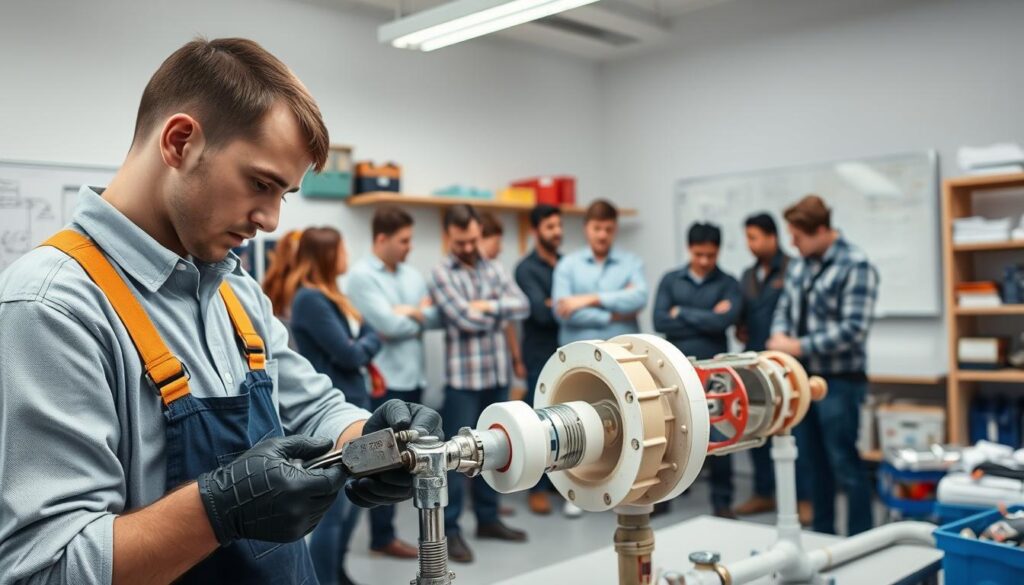
In your journeyman plumber training, you’ll learn a lot. You’ll get 144 to 180 hours of classroom time each year. This helps you learn by doing.
In-School Training Hours by Province
How many hours you spend in class depends on where you are and your program. Most places need you to do:
- Four eight-week blocks of training each year
- 20% of your apprenticeship in classroom learning
- Classes that fit your schedule, like evenings or short periods
Core Curriculum and Subject Areas
The training covers many important topics. You’ll learn about:
- Plumbing basics and theory
- Building codes, local and national
- Reading and understanding blueprints
- Advanced piping systems
- Safety and work procedures
- Math and physics for plumbing
“Technical education transforms an apprentice into a skilled professional through structured learning and practical knowledge.” – Professional Trades Association
To pass, you need to keep good grades and show you really get the plumbing concepts.
Journeyman Plumber Training and Certification Process
Becoming a journeyman plumber is a big step in your plumbing career. It means you’re no longer an apprentice but a skilled tradesperson who can work on their own. To get there, you need to put in a lot of effort, learn technical skills, and meet several important requirements.
The certification process has three main parts:
- Complete required on-the-job training hours (typically 8,000-10,000 hours)
- Finish all classroom technical training with passing grades
- Pass your state’s official journeyman licensing examination
Your journeyman plumber training exam will test your knowledge in many areas. The exam covers:
- Plumbing theory and technical principles
- Local and national building codes
- System design and installation techniques
- Safety protocols and professional practices
To get certified, you must score at least 70-75% on the exam. Most states want you to show you can do the job as well as know the theory. Preparation is key to successfully completing your journeyman plumber training.
Once you pass the exam, you’ll get your official journeyman plumber license. This license opens up many career doors. You can work on your own, earn more money, and even start working towards becoming a master plumber.
Master Plumber Certification and Red Seal Endorsement
Reaching the master plumber level is a big step in your career. It opens up new chances, better pay, and more respect in the plumbing world.
To get your master plumber certification, you must meet several requirements:
- Get at least 4-5 years of experience as a journeyman plumber.
- Pass a tough master plumber exam.
- Show you have top-notch technical and management skills.
- Follow the rules for licenses in your state.
Interprovincial Standards and Mobility
Having a master plumber license makes your career more flexible. Many states let you use your license with little extra testing. This means you can work in different places.
Certificate of Qualification Examination Requirements
The master plumber exam tests you on hard topics. You’ll need to know:
- How to design complex systems.
- How to understand and apply codes.
- How to do hydraulic calculations.
- Business management basics.
- How to follow rules and regulations.
“Becoming a master plumber is not just about technical skills, but about demonstrating complete professional expertise.” – Professional Plumbing Association
Getting a plumbing license at the master level takes a lot of time and effort. Exam fees are between $250 and $500. You’ll also need to pay for study materials and prep courses.
The path to becoming a master plumber is the highest achievement in plumbing. Your hard work will pay off with better job chances and higher pay.
Plumbing Skills Needed for Success in the Trade
To be a top plumber, you need more than just pipe skills. You must have technical know-how and personal traits. Plumbers need to know a lot, from fixing pipes to solving complex problems.
Being good at plumbing starts with technical skills. You’ll learn advanced plumbing skills like:
- Precise tool handling (hand and power tools)
- Blueprint interpretation
- Understanding complex plumbing systems
- Welding and soldering techniques
- Knowledge of modern piping technologies
Being able to solve problems is key. Plumbers must find and fix issues fast. They need to think critically and creatively.
| Skill Category | Key Competencies |
|---|---|
| Technical Skills | Tool expertise, system understanding |
| Analytical Skills | Problem diagnosis, critical thinking |
| Soft Skills | Communication, customer service |
Soft skills are important too. Good communication, customer service, and time management are vital. You also need physical strength, attention to detail, and a love for learning.
Remember, plumbers must always keep learning. They need to stay up-to-date with new tech, codes, and standards. Your ability to adapt and learn will make you successful in this field.
Career Path Advancement and Earning Potential
Starting a plumbing career opens doors to growth and financial rewards. As you move up, you’ll find many ways to improve your skills and boost your income.
First, you’ll start as an apprentice, earning about $15-$20 an hour. With more experience and certifications, your pay will go up. Plumbing careers lead to many high-paying jobs.
Supervisory Positions and Self-Employment
As you get more experience, you can take on new roles:
- Foreman or project manager roles
- Plumbing inspector positions
- Independent contractor
- Business owner
About 12-15% of plumbers go into business for themselves. This path offers more freedom and the chance to earn more.
Salary Ranges and Regional Variations
| Career Stage | Hourly Wage Range | Annual Earnings |
|---|---|---|
| Apprentice | $15 – $20 | $31,200 – $41,600 |
| Journeyman | $25 – $40 | $52,000 – $83,200 |
| Master Plumber | $50 – $80+ | $104,000 – $166,400 |
Note: Earnings vary based on location, specialization, and experience. Plumbers in cities usually make 20-30% more than those in rural areas. Specializing in areas like industrial plumbing can also increase your earnings.
Conclusion
Exploring what it takes to become a plumber shows a career full of chances and hurdles. It’s more than a job; it’s a path to a stable, fulfilling career. This career offers both personal and financial growth.
Getting into plumbing requires hard work and careful planning. It usually takes 4-5 years of education, apprenticeship, and certification. You’ll need to spend time on technical training, hands-on experience, and keeping your skills sharp.
The plumbing field is changing with new tech and green buildings. You can move up to supervisory roles, start your own business, or specialize in new systems. Plumbing offers job security, good pay, and the joy of solving tough problems.
To begin, look into local apprenticeships, talk to plumbing contractors, and check your education needs. Your dedication to learning this trade can lead to a future of independence and success.