

Affiliate Disclosure
Plumber Guide Guys is a participant in the Amazon Services LLC Associates Program, an affiliate advertising program designed to provide a means for sites to earn advertising fees by advertising and linking to Amazon.
How to Get Certified as a Plumber? Did you know plumbers in the U.S. can make up to $56,330 a year? The best ones can earn over $97,170. To become a certified plumber, you need more than just technical skills. It’s important to know the plumbing certification requirements to start a successful career.
The path to getting certified is complex. It involves education, training, and licensing. Each state has its own rules, so it’s key to understand the specific steps for becoming a professional plumber.
Getting certified is not just a formality. It’s a detailed process that shows you have the skills, knowledge, and legal right to work in plumbing. You’ll need to go through apprenticeships and pass state-specific exams. The journey requires dedication and careful planning.
Key Takeaways
- Certification is mandatory in most U.S. states
- Requirements vary significantly by state
- Apprenticeship is a key part of certification
- Professional credentials can boost earning power
- Continuous learning is vital in plumbing
Table of Contents
Understanding Plumbing Certification Basics
Getting into plumbing certification can seem tough, but knowing the basics is key to a great career. Each level of certification has its own set of rules and marks a big step in your career.
The plumbing world has many certification levels. Each one comes with its own set of challenges and chances for growth:
- Apprentice Plumber: This is the starting point, needing supervised training.
- Journeyman Plumber Certification: This is the next step, allowing more freedom in your work.
- Master Plumber Exam: This is the top level, with big responsibilities and a lot of knowledge.
Career Progression in Plumbing
Your plumbing career has a clear path. You start as an apprentice, learning by doing under a pro’s watch. When you get your journeyman plumber certification, you can do more on your own, like big installations and fixes.
Benefits of Professional Certification
Getting certified in plumbing brings many benefits:
- You can earn more money.
- You’ll have more job options.
- You’ll be seen as more credible in your field.
- You’ll be allowed to do more complex work legally.
Getting certified shows you’re serious about your work. It opens up better job chances in construction and maintenance.
Educational Requirements for Plumber Certification
To become a professional plumber, you need to invest in education and training. A trade school for plumbers gives you the basics to start your plumbing career. These programs offer in-depth training for the plumbing world.
Plumbing apprenticeships mix classroom learning with hands-on practice. They follow a set plan to teach you both theory and practical skills:
- Classroom-based technical instruction
- Practical workshop training
- Safety and professional practice courses
- Mathematics and blueprint reading
Here’s how you can become a plumber:
| Education Level | Duration | Key Components |
|---|---|---|
| Trade School Certificate | 6-24 months | Basic plumbing theory, technical skills |
| Apprenticeship Program | 4-5 years | Supervised on-the-job training, technical education |
| Advanced Certification | Ongoing | Specialized skills, continued learning |
Apprenticeship requirements differ by state, but usually, you need 4 years of both classroom and practical training. Choose a quality trade school for plumbers to lay a solid foundation for your career.
Pro tip: Look into local community colleges and technical schools with plumbing programs to kickstart your career.
How to Get Certified as a Plumber
Becoming a certified plumber takes careful planning and dedication. The plumbing license application process has several key steps. These steps turn aspiring professionals into skilled trade experts. Knowing these requirements helps you on your certification journey.
Certification is more than a piece of paper. It’s your professional passport in the plumbing industry. Each state has its own rules, but most follow a similar path to get certified.
Step-by-Step Certification Process
- Complete an accredited plumbing education program
- Enroll in a registered apprenticeship
- Accumulate required work experience hours
- Pass state-specific licensing examinations
- Submit a complete application with all necessary documents
Required Documentation
Your plumbing license application needs thorough documentation. Before applying, gather these essential documents:
- High school diploma or equivalent
- Apprenticeship completion certificate
- Verified work experience log
- Proof of completed training hours
- Professional references
Application Procedures
When applying, pay close attention to detail. Review all requirements, pay fees, and make sure all documents are up-to-date and correct.
“Precision in your application is as important as precision in your plumbing work.” – Professional Plumbing Association
Processing times usually take 4-8 weeks. Some states offer online application systems. This makes the certification process easier for aspiring plumbers.
Apprenticeship Programs and Requirements
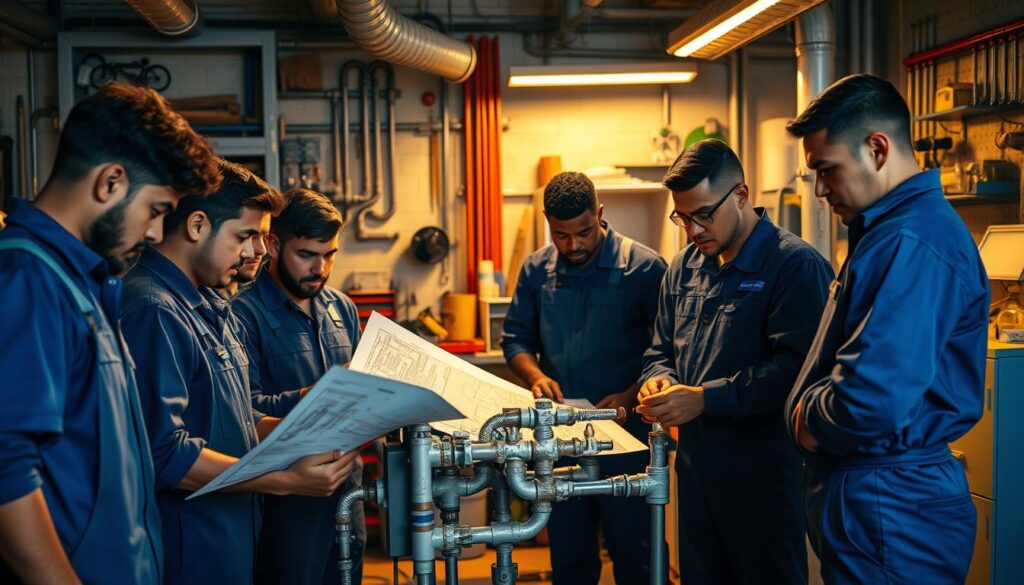
Starting your journey to become a professional plumber involves understanding apprenticeship programs. These programs offer the skills and knowledge needed for a successful career. They aim to make plumbers ready for complex challenges.
Plumber apprenticeship programs mix classroom learning with practical experience. You’ll spend 4-5 years learning, which includes:
- 144 hours of classroom instruction annually
- 2,000 hours of paid on-the-job training each year
- Technical education in mathematics, physics, and specialized plumbing techniques
- Safety protocols and building code regulations
To join a plumbing apprenticeship, you must meet certain requirements. Most programs ask for:
- Minimum age of 18 years
- High school diploma or equivalent
- Passing an entrance exam
- Physical fitness for demanding work
Apprenticeship programs offer more than just technical skills. You’ll earn a good wage, build professional connections, and gain real-world experience. Many apprentices find jobs before finishing their training.
“An apprenticeship is your pathway to a stable, rewarding career in plumbing.” – Professional Plumbers Association
Think about the financial side too. Apprenticeships often start with competitive wages that increase as you learn more. Your earning power grows with each year of training.
State-Specific Licensing Requirements
Understanding state plumbing license rules can be tricky. Each state has its own set of rules for becoming a certified plumber. Knowing these differences is key for your career.
Getting a plumbing license varies across the U.S. Your journey to becoming a licensed plumber depends on your location.
Variations Across States
State rules for plumbing licenses can change a lot. Some main differences include:
- How long you need to work before getting certified
- The type of exams you must take
- The level of education needed
- The minimum age to start
Reciprocity Agreements
Some states have agreements that make it easier to work across state lines. These agreements help plumbers move their licenses more smoothly.
These agreements usually depend on:
- Similar training standards
- The same exam processes
- Comparable work experience needs
License Renewal Requirements
To keep your plumbing license, you must stay committed. Most states require:
- Renewing your license at set times
- Completing continuing education
- Keeping your professional info up to date
- Pay renewal fees
Pro tip: Always check your specific state’s current licensing board for the most up-to-date requirements to ensure full compliance.
Examination Preparation and Testing
Passing the master plumber exam and getting your journeyman plumber certification needs careful prep. You’ll be tested on your technical skills, practical abilities, and grasp of complex plumbing systems.
Your prep should cover a few main areas:
- Comprehensive review of local plumbing codes
- Understanding theoretical and practical plumbing principles
- Mastering safety regulations
- Practicing technical problem-solving skills
Most places need you to show you’re good at both written and practical tests. The master plumber exam will test you on advanced stuff like:
- Advanced pipe system design
- Complex installation techniques
- Intricate drainage and water supply configurations
- Commercial and industrial plumbing standards
To ace your journeyman plumber certification, spend time on studying. Look into exam prep courses, practice tests, and study groups. They can boost your knowledge and confidence.
Effective preparation is the key to passing your plumbing certification exams and launching a successful professional career.
Keep in mind, each state has its own testing rules. Always check with your local licensing board for the latest info.
Experience Requirements and Documentation
Understanding the plumbing certification requirements can be tough. But knowing how to document your experience is key to applying for a plumbing license. Each state has its own rules for checking and confirming your work experience in plumbing.
Plumbers need to document their work experience to meet certification standards. This involves several important steps:
Work Hour Requirements
Here are the typical experience needs for plumbing certification:
- At least 4-8 years of documented work experience
- Hour requirements vary by state and certification level
- Hours must cover different types of plumbing installations
Supervision Guidelines
Your work experience must follow strict supervision rules:
- Work must be done under a licensed master plumber
- Direct supervision is needed for apprentice-level work
- Documented oversight ensures quality and safety
Documentation Methods
Proper documentation is vital to prove your experience. Here are some recommended methods:
- Detailed work logs with project descriptions
- Employer verification forms
- Signed statements from supervising plumbers
“Accurate documentation is the key to successful plumbing certification.” – Professional Plumbing Association
Always check your state’s plumbing certification requirements. Guidelines can vary a lot between places.
Specialization and Advanced Certifications
Getting ahead in plumbing is more than just basic certifications. Specialized certifications can really help your career. They open up new opportunities and can increase your pay.
Plumbers can choose from many specializations. These paths help them grow their skills and stand out in the job market.
- Medical Gas Piping Installation
- Backflow Prevention Systems
- Water Treatment Technologies
- Green Plumbing Solutions
- Industrial Pipeline Systems
The master plumber exam is the top achievement in plumbing. You need lots of experience and deep knowledge of advanced skills to pass.
| Specialization | Additional Training Required | Average Salary Increase |
|---|---|---|
| Medical Gas Certification | 40-80 hours | 15-25% |
| Backflow Prevention | 20-40 hours | 10-20% |
| Green Plumbing | 30-60 hours | 12-22% |
Each specialization has its own set of requirements. You’ll need to pass extra exams. Getting these certifications shows you’re serious about your career and skills.
Keep in mind, rules for certifications vary by state. Always check with your local licensing board for the latest on your chosen area.
Insurance and Bonding Requirements
Getting a state plumbing license means you need to know about insurance and bonding. These are important for your safety and your clients’. They show you’re serious about being a pro.
Plumbing licenses often ask for certain insurance. This insurance protects your business and your clients. Plumbers usually need:
- General Liability Insurance
- Workers’ Compensation Insurance
- Professional Liability Insurance
- Commercial Auto Insurance
Bonding adds more protection. It’s like a promise to do the job right and meet your duties. The bond amount changes based on:
- How much work you do each year
- The plumbing services you offer
- How big your business is
- Local rules
Every state has its own rules for insurance and bonding for plumbers. It’s key to check your state’s rules to make sure you’re covered.
Having the right insurance and bonding doesn’t just protect you. It also helps build trust with clients and shows you’re a pro.
Continuing Education and License Maintenance
Keeping your state plumbing license means you must keep learning. You need to stay up-to-date with new standards, technologies, and safety rules. As a certified plumber, you must complete certain training to keep your license valid.
Every state has its own rules for continuing education. These rules help you offer top-notch service and keep up with industry changes.
Required Training Hours
Here’s what you usually need:
- 8-24 hours of approved training each year
- Courses that improve your technical skills and keep you informed
- At least 4 hours on safety and code compliance
Approved Course Topics
When you renew your license, you’ll need to take courses on:
- Updates to plumbing codes
- Advanced installation methods
- Green plumbing technologies
- Safety measures
- Managing your plumbing business
Renewal Deadlines
Don’t forget about your license renewal. Most states require:
- Renewal every year or two
- Showing proof of continuing education
- Paying renewal fees
Pro tip: Keep track of your training hours and renewal dates to avoid losing your license.
Conclusion
Getting certified as a plumber takes hard work and careful planning. You need to understand the complex rules and state laws. Your dedication to learning and meeting standards will help you succeed in this field.
The path to becoming a plumber involves many steps. You must complete education, join apprenticeships, and pass tough exams. Each state has its own rules and chances for plumbers. With thorough training, enough work hours, and keeping up with industry trends, you can build a strong career.
Getting certified can lead to better jobs and more money. Remember, your certification is a lifelong journey of learning and staying updated. Keep learning, update your licenses, and be ready for new plumbing technologies and rules.
Your success in plumbing depends on your commitment to learning and meeting state rules. The plumbing world values skilled, reliable, and passionate professionals. Show your expertise and love for plumbing to thrive in this field.
FAQ
How long does it take to become a certified plumber?
Do I need a high school diploma to become a plumber?
What are the different levels of plumbing certification?
How much does plumber certification cost?
How long does it take to become a certified plumber?
Do I need a high school diploma to become a plumber?
What are the different levels of plumbing certification?
How much does plumber certification cost?
FAQ
How long does it take to become a certified plumber?
It usually takes 4-5 years to become a certified plumber. This includes 4-5 years of both classroom learning and on-the-job training. After that, you need to pass the state’s licensing exams.
Do I need a high school diploma to become a plumber?
Yes, most states and apprenticeship programs require a high school diploma or GED. This is important for learning technical and math skills needed in plumbing.
What are the different levels of plumbing certification?
Plumbing certifications come in three levels: Apprentice, Journeyman, and Master Plumber. Each level requires more training, experience, and passing exams to move up.
How much does plumber certification cost?
Certification costs vary by state, from 0 to 0. This includes fees for applications, exams, and training programs. Apprenticeship programs can cost between
FAQ
How long does it take to become a certified plumber?
It usually takes 4-5 years to become a certified plumber. This includes 4-5 years of both classroom learning and on-the-job training. After that, you need to pass the state’s licensing exams.
Do I need a high school diploma to become a plumber?
Yes, most states and apprenticeship programs require a high school diploma or GED. This is important for learning technical and math skills needed in plumbing.
What are the different levels of plumbing certification?
Plumbing certifications come in three levels: Apprentice, Journeyman, and Master Plumber. Each level requires more training, experience, and passing exams to move up.
How much does plumber certification cost?
Certification costs vary by state, from $100 to $500. This includes fees for applications, exams, and training programs. Apprenticeship programs can cost between $1,000 to $5,000.
Can I become a plumber without an apprenticeship?
Most states require a formal apprenticeship to become a certified plumber. Apprenticeships provide hands-on training and are needed to qualify for licensing exams.
What skills do I need to become a successful plumber?
You need mechanical aptitude, physical strength, and problem-solving skills. Also, good math skills, customer service, attention to detail, and comfort in tight spaces are important.
Do plumbing licenses transfer between states?
Some states allow plumbers to transfer licenses, but many require more testing or documentation. Always check with the state’s licensing board for specific requirements.
What is the average salary for a certified plumber?
Plumbers earn a median annual wage of $56,330, with top earners making over $97,000. Salaries vary based on location, experience, and specialization.
How often do I need to renew my plumbing license?
Renewal periods for licenses vary, from 1-3 years. Most states require continuing education and a renewal fee to keep your license active.
Are there specialized certifications in plumbing?
Yes, plumbers can get specialized certifications in areas like medical gas systems and green plumbing. These certifications can open up more job opportunities and increase earnings.
,000 to ,000.
Can I become a plumber without an apprenticeship?
Most states require a formal apprenticeship to become a certified plumber. Apprenticeships provide hands-on training and are needed to qualify for licensing exams.
What skills do I need to become a successful plumber?
You need mechanical aptitude, physical strength, and problem-solving skills. Also, good math skills, customer service, attention to detail, and comfort in tight spaces are important.
Do plumbing licenses transfer between states?
Some states allow plumbers to transfer licenses, but many require more testing or documentation. Always check with the state’s licensing board for specific requirements.
What is the average salary for a certified plumber?
Plumbers earn a median annual wage of ,330, with top earners making over ,000. Salaries vary based on location, experience, and specialization.
How often do I need to renew my plumbing license?
Renewal periods for licenses vary, from 1-3 years. Most states require continuing education and a renewal fee to keep your license active.
Are there specialized certifications in plumbing?
Yes, plumbers can get specialized certifications in areas like medical gas systems and green plumbing. These certifications can open up more job opportunities and increase earnings.