
Affiliate Disclosure
Plumber Guide Guys is a participant in the Amazon Services LLC Associates Program, an affiliate advertising program designed to provide a means for sites to earn advertising fees by advertising and linking to Amazon.
How to Estimate Plumbing Costs? Did you know the average homeowner in the U.S. spends $170 to $450 on plumbing repairs? Some jobs can cost up to $15,000. Knowing how to estimate costs is key. It’s what makes plumbing pros successful, not just contractors.

Estimating plumbing costs is more than simple math. It’s about strategy. You need to consider labor, materials, overhead, and profit. Whether you’re small or growing, getting this right can change your finances.
This guide will teach you how to make accurate, profitable estimates. You’ll learn how to calculate costs, set prices, and keep your business healthy.
Key Takeaways
- Learn precise techniques for calculating plumbing project costs
- Understand the critical components of accurate cost estimation
- Discover methods to maximize profit without overcharging customers
- Develop a systematic approach to pricing plumbing services
- Gain insights into overhead cost recovery and profit margin strategies
Table of Contents
Understanding the Foundation of Plumbing Cost Estimation
Plumbing cost estimation is more than just throwing numbers on a piece of paper. It’s a strategic process that separates successful contractors from struggling businesses. Your ability to create accurate estimates directly impacts your profitability and customer trust.
Cost Analysis requires a detailed approach. Every expense counts—from the plumber’s hours to the van’s fuel and even the smallest tube of sealant. Missing these details can cut into your earnings.
Why Accurate Cost Estimation Matters for Your Business
Precision in pricing isn’t just about covering expenses. It’s about creating a sustainable business model. Your estimates should reflect:
- True labor costs
- Material expenses
- Overhead and operational costs
- Desired profit margins
Moving Beyond Guesswork in Plumbing Pricing
Profit Planning isn’t what’s left after expenses—it’s a deliberate strategy. Treating profit as a required line item ensures your business grows, not just survives. Professional contractors understand that each job must contribute to long-term financial health.
The Three Pillars of Profitable Plumbing Estimates
Customer Communication stands at the core of successful estimating. Your quotes need to be clear, transparent, and detailed. Breaking down costs helps clients understand the value you provide:
- Transparency builds trust
- Detailed explanations reduce price objections
- Professional presentation differentiates you from competitors
“An estimate is more than a price—it’s a promise of value and professionalism.”
By mastering these estimation fundamentals, you transform from a simple service provider to a trusted plumbing professional clients want to hire repeatedly.
Choosing the Right Pricing Model for Your Plumbing Jobs
Choosing the right pricing model is key for your plumbing business. It affects your profits, customer happiness, and how you stand out in the market.
Plumbing pros often pick from three main pricing ways:
- Hourly Rate Pricing: Charging by the hour for work done
- Flat Rate Pricing: A set price for certain services
- Cost-Plus Pricing: Adding a markup to both materials and labor
Now, let’s look at each pricing method to help you decide:
| Pricing Model | Pros | Cons |
|---|---|---|
| Hourly Rate | Clear billing | Customers might be hesitant |
| Flat Rate | Customers know what to expect | May not cover all job costs |
| Cost-Plus | Ensures profit | Needs detailed cost tracking |
When picking a pricing model, think about your local market, what customers like, and your business’s special features. Each method has its good points. The best choice often mixes different strategies to fit your plumbing services.
Consider job complexity, time needed, material costs, and who you’re aiming to serve. Your pricing should show your skill while being fair and competitive.
How to Estimate Plumbing Cost Using Loaded Labor Rates
Knowing your true labor costs is key to a profitable plumbing business. Your hourly rate isn’t just the base wage. It includes direct and indirect expenses that affect your profit.
To find your fully loaded labor rate, you must consider many financial factors. A technician earning $35/hour with a 30% burden rate adds $10.50 in costs. This makes the true hourly rate $45.50.
Breaking Down Labor Cost Components
- Base wage: $35/hour
- Burden costs: $10.50/hour (30% of base wage)
- Payroll taxes (FICA)
- Workers’ compensation insurance
- Health insurance contributions
- Retirement plan investments
Developing Tiered Plumber Rates
Professional plumbing services need a smart pricing strategy. In 2025, rates average $90/hour but can vary from $45 to $200. This depends on the job’s complexity and location.
Creating a three-tiered rate system helps with accurate pricing:
- Apprentice Level: Lower rates for learning technicians
- Journeyman Level: Mid-range rates for experienced professionals
- Master Plumber Level: Premium rates for complex installations
Real-World Rate Considerations
Emergency calls can cost up to $300/hour. Urban areas charge 30-50% more than rural ones. Your pricing must balance these factors for profit and competitiveness.
Strategic Material Markup Methods That Maximize Profit
Pricing your plumbing materials is key to your business’s success. Using smart markup strategies helps cover costs and keep prices competitive. This is true for all types of products.
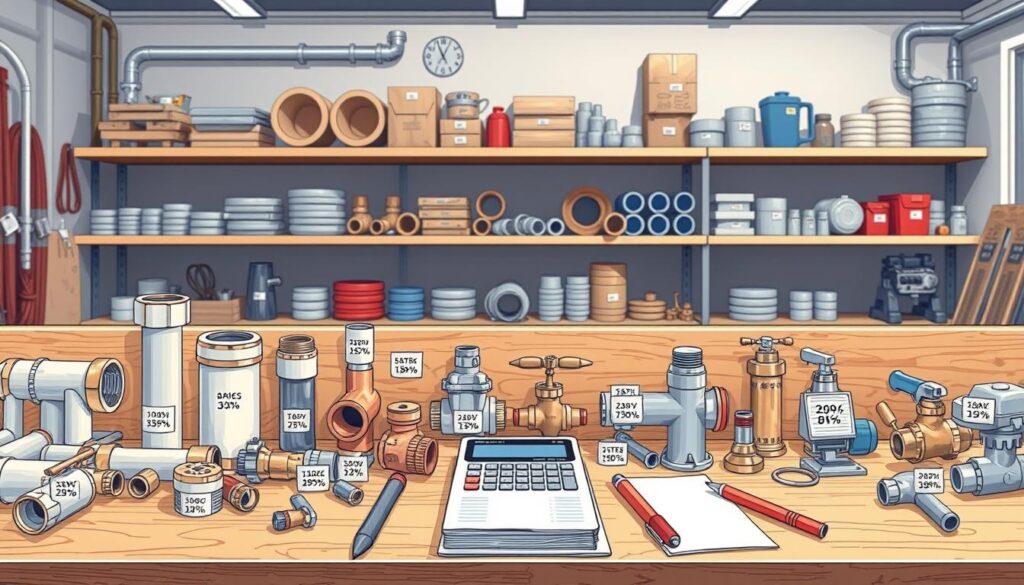
Professional plumbers know that pricing materials differently is essential. Each product category needs its own strategy to keep the business running smoothly.
Implementing a Tiered Material Markup System
Develop a strategic markup approach based on item value and complexity:
- $1-$25 items: 150-300% markup (e.g., a $6 wax ring sold for $15)
- $26-$100 items: 75-150% markup (e.g., a $50 ball valve sold for $125)
- $101-$500 items: 30-75% markup (e.g., a $300 disposal sold for $420)
- $501+ items: 15-30% markup (e.g., a $1,000 tankless heater sold for $1,200)
Accounting for Consumables and Small Parts
Small parts might seem small, but they add up fast. There are two ways to cover these costs:
- Add a standard sundries fee to every service call
- Slightly increase overall material markups to absorb consumables like solder, thread sealant, and fasteners
Always negotiate with suppliers for volume discounts. Even a 5% reduction in material costs can greatly boost your annual profits.
Calculating and Recovering Your Overhead Costs
Knowing your overhead recovery rate is key to a profitable plumbing business. Overhead includes costs like office expenses, vehicle maintenance, insurance, and salaries for admins.
To figure out your overhead recovery rate, let’s use an example. A plumbing business has $8,000 monthly overhead. With 240 billable hours (2 plumbers working 120 hours each), the rate is $33.33 per hour.
- Identify total monthly overhead expenses
- Calculate total monthly billable hours
- Divide overhead by billable hours
So, each billable hour must earn $33.33 to cover costs. Not charging enough means losing money with each hour.
| Expense Category | Monthly Cost |
|---|---|
| Vehicle Expenses | $2,500 |
| Office Rent | $1,800 |
| Insurance | $1,200 |
| Administrative Salaries | $2,500 |
| Total Monthly Overhead | $8,000 |
Monitoring your overhead recovery rate helps set the right prices. It keeps your business financially stable. Understanding these figures guides your pricing and business decisions.
Building Sustainable Profit Margins Into Every Estimate
Successful plumbing businesses know profit is key, not just extra money. Your pricing strategy can make or break your business.

To calculate your job subtotal, you need a smart plan. Add loaded labor costs, marked-up materials, and overhead recovery. The formula is: Job Subtotal (Loaded Labor + Marked-Up Materials + Overhead Recovery) × Target Profit % = Profit Amount. Then, add the profit to the subtotal to get the final price.
Setting Target Profit Percentages by Job Type
Profit margins vary by job type. Here are some common ranges:
- Residential repairs: 15-25%
- Commercial installations: 20-35%
- Emergency services: 30-45%
| Job Type | Complexity | Recommended Profit % |
|---|---|---|
| Simple Repairs | Low | 15-20% |
| Complex Installations | High | 25-35% |
| Specialized Services | Very High | 35-45% |
Understanding Profit vs. Salary
Many contractors confuse their salary with business profit. Profit is the financial cushion that fuels business growth, while your salary is part of overhead costs.
Profit enables investment in equipment, training, and business expansion—it’s not just extra money, but your company’s strategic resource.
By planning for profit in your pricing, you build a strong business. This business can handle tough times and grow when opportunities arise.
Factors Affecting Plumbing Costs in Residential Projects
Knowing about residential plumbing costs is key for homeowners and contractors. Plumbing systems in homes are complex. They bring in clean water, manage wastewater, and handle drainage for all home sizes.
The cost of your plumbing system depends on several factors. These factors affect the final price of plumbing work:
- Home age and existing pipe conditions
- Total number of fixtures and bathrooms
- Water source (municipal vs. well systems)
- Waste disposal method (sewer vs. septic)
Common Residential Plumbing Repair Price Ranges
Repair costs vary based on the service needed. Simple fixture replacements cost between $100 and $500. Drainage system repairs can range from $500 to $3,000.
“Understanding your home’s unique plumbing characteristics is key to accurate cost estimation.” – Professional Plumbing Association
Installation Complexity and System Type Considerations
The complexity of your sewage system affects the price. Older homes need more work. Pipe accessibility, local codes, and material choices like PEX or copper also impact costs.
When planning plumbing projects, remember these key factors. They help in accurate cost estimation and avoid surprises.
Commercial Plumbing Cost Estimates and Considerations
Commercial plumbing projects need a special way to estimate costs. Getting the cost right is key to making your business profitable in the commercial world.
When you’re working on commercial plumbing estimates, there are a few important things to think about:
- Scale of the project
- Complexity of building systems
- Specialized equipment requirements
- Regulatory compliance standards
- Potential access and installation challenges
Commercial jobs are priced differently than residential ones. Big projects need more detailed planning and risk checking. You should have a detailed estimation process that covers:
- Extended labor hours
- Advanced technical skills
- Higher-quality materials
- Special permits and inspections
Your commercial plumbing estimates should have a 10-15% contingency budget for surprises. Industrial and commercial spaces often have unique challenges that homes don’t face.
Good commercial plumbing cost estimation is about being precise, assessing risks well, and setting competitive prices. Your aim is to give clear, accurate quotes that protect your business and meet client needs.
Using a Plumbing Cost Calculator and Budget Planning Tools
Digital technology has changed how plumbing businesses estimate costs and manage projects. Today, plumbers use advanced tools that make their work easier, from the first quote to the final bill.
- A detailed database of labor rates for each technician tier
- A library of material costs with markup percentages already figured out
- Tools to track overhead recovery rates
- Settings for profit margins based on job type
Essential Components of Effective Project Budget Planning
Good budget planning means having estimating templates for common tasks. These templates help you make quick, accurate quotes. You won’t have to start over every time.
“Know your numbers, price deliberately, and communicate value effectively.” – Plumbing Business Strategy Wisdom
Digital tools let you compare actual costs to estimates. This gives you insights to improve your pricing. Modern plumbing cost calculators work well with your:
- Scheduling system
- Parts inventory management
- Accounting software
How to Present Clear and Transparent Quotes to Customers
Building trust with quotes means being open. Your estimates should have clear sections for labor, materials, and any extra fees.
Use your quote to teach customers about your work. Show them:
- Years of training
- Special tools and skills
- Insurance and licenses
- Warranty coverage
Clear, detailed quotes set you apart from competitors. They show you’re not just about the lowest price. Smart budget planning makes a plumbing business thrive, not just survive.
Conclusion
Plumbing pros need to calculate their fully loaded labor costs accurately. This guide helps you avoid simple pricing that can harm your business. By using tiered markups on materials, you can make more profit while staying competitive.
Recovering all overhead costs in every billable hour changes your pricing approach. Contractors who add profit margins can invest in growth. Your pricing strategy helps keep your business stable and delivers great value to customers.
Property owners learn the real value of professional plumbing services. It’s not just about the work done. You’re paying for expertise, licenses, insurance, and more. This ensures reliable support in the future.
Understanding your business costs, choosing the right pricing models, and making clear quotes is key. By following these steps, you help the plumbing industry grow and become more professional.