

Affiliate Disclosure
Plumber Guide Guys is a participant in the Amazon Services LLC Associates Program, an affiliate advertising program designed to provide a means for sites to earn advertising fees by advertising and linking to Amazon.
How to Become a Plumber in Georgia? Are you ready to unlock a skilled trade that offers stability, decent pay, and endless opportunities? What if becoming a plumber could be your ticket to a rewarding career in Georgia?

Plumbing is more than just fixing pipes. It’s a vital profession that keeps homes, businesses, and communities running smoothly. In Georgia, becoming a licensed plumber requires careful planning, dedicated training, and meeting specific state requirements.
This guide will take you through every step of turning your passion into a professional plumbing career. You’ll learn about licensing requirements and apprenticeship programs. You’ll discover what it takes to succeed in this dynamic field.
Key Takeaways
- Plumbing offers a stable career with competitive wages in Georgia
- State-specific licensing is mandatory for professional plumbers
- Apprenticeship programs provide essential hands-on training
- Multiple license types exist for different skill levels
- Physical fitness and technical skills are key for success
Understanding Georgia Plumber License Requirements
To become a professional plumber in Georgia, you must meet certain requirements. These go beyond just wanting to work in the trade. The state has set clear rules to make sure new plumbers are ready for the job’s physical and legal aspects.
Those interested in plumbing must know the detailed requirements. These show they’re ready for the tough work ahead. Plumbing is physically demanding, needing certain skills that not everyone has.
Age and Education Prerequisites
To start a plumbing career in Georgia, you must meet age and education standards:
- Minimum age requirement of 18 years old
- High school diploma or GED equivalent
- Basic understanding of mathematics and physics
- Strong problem-solving skills
Physical Ability Requirements
Plumbing is a tough job that needs certain physical skills. You’ll need strength to lift heavy items like pipes and water heaters. You also need stamina for long hours of standing and walking.
Most programs and employers require a physical exam and drug test. This checks if you can handle the job’s physical needs. Your ability to work precisely with tools and fittings is key to your success.
The Georgia Secretary of State’s Office, through the Division of Master and Journeyman Plumbers, oversees plumbing licenses. Working without proper licensure is illegal and can result in significant penalties.
Types of Plumbing Licenses Available in Georgia
Starting a plumbing career means knowing about different licenses. Georgia has three main licenses based on your experience and skills.
To begin, you need a Journeyman License. It requires 3 years of experience. You can do plumbing work but only under a master plumber’s watch. Think of it like being an employee who needs a boss.
- Minimum 3 years of qualifying experience
- Works under a master plumber’s supervision
- Can perform most standard plumbing services
The next step is the Master License Class 1 Restricted. You need 5 years of experience, 2 of which as a journeyman. Your work is limited to:
- Single-family homes
- Two-family buildings
- Commercial structures under 10,000 square feet
The Master License Class 2 Unrestricted offers more freedom. It needs 5 years of experience, 2 as a journeyman, and commercial plumbing experience. This license has no work size limits.
| License Type | Experience Required | Work Limitations |
|---|---|---|
| Journeyman | 3 years | Must work under master plumber |
| Master Class 1 Restricted | 5 years (2 as journeyman) | Residential and small commercial projects |
| Master Class 2 Unrestricted | 5 years (2 as journeyman) | No project size restrictions |
Only master plumbers can own businesses and bid on jobs. Your license shows your skills and career growth in plumbing.
How to Become a Plumber in Georgia
To start a plumbing career in Georgia, you need a plan and to know about experience needs. The state has a flexible way to get licensed. It mixes work experience with education.
Understanding primary and secondary experience is key to your plumbing career. These paths help you reach your goals in different ways.
Gaining Primary Experience
Primary experience is the base of your plumbing career. It’s hands-on work under a licensed plumber’s watch. You learn by doing on the job.
- Work directly with experienced plumbers
- Learn on-the-job installation techniques
- Understand complex plumbing systems
- Gain real-world problem-solving skills
Accumulating Secondary Experience
Georgia has special chances to speed up your licensure with secondary experience. Getting a diploma from a technical school in engineering technology can count for up to two years of secondary experience. Also, a certificate from a vocational-technical school can count for up to one year of secondary experience.
This system lets you mix education with work. It could make your path to journeyman or master licensure shorter. You’ll gain both practical and theoretical knowledge.
- Technical school diploma: Up to 2 years of secondary experience
- Vocational certificate: Up to 1 year of secondary experience
- Meet journeyman licensure (3-year requirement)
- Advance to master licensure (5-year requirement)
Knowing and using these experience paths helps you plan. You’ll know how to get the experience needed for your license.
Georgia Plumber Training Programs and Schools
Starting a plumbing career in Georgia means more than just learning technical skills. You’ll explore important topics like underground water systems, stormwater management, and sewer systems.
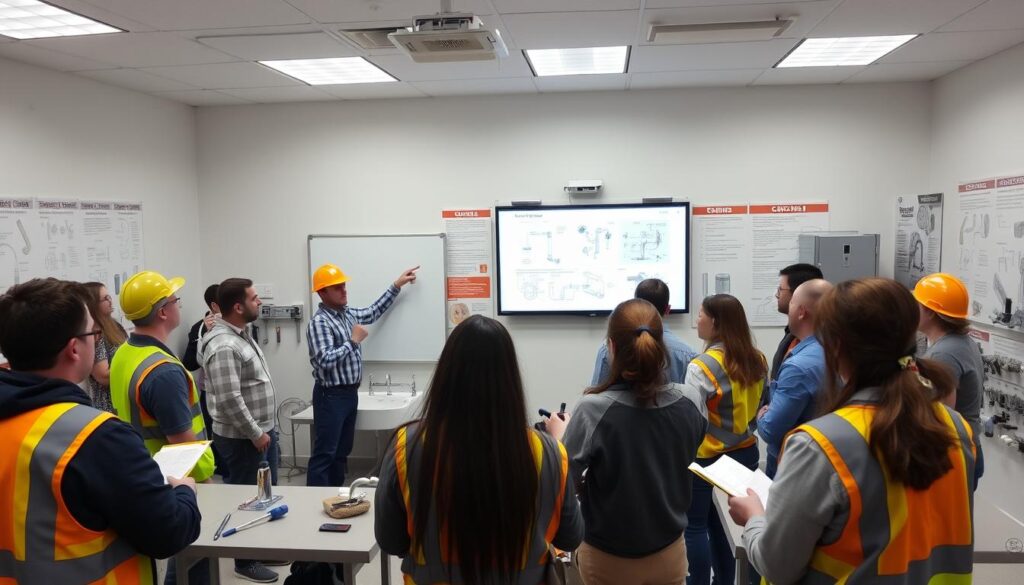
Good plumbing programs give you a solid education for both home and business plumbing. You’ll learn about:
- How to install fixtures
- Waste and vent piping for inside and outside
- OSHA safety training
- Advanced water treatment systems
These programs also cover essential technical and scientific subjects:
- Chemistry for water treatment
- Math for pipe sizing
- Physics for understanding pressure and thermodynamics
- Blueprint reading and drafting
Costs vary a lot. Certificate programs cost between $1,250 and $3,000. Associate degree programs can be $3,000 to $23,000, depending on the school.
“Investing in quality education provides the theoretical foundation to become a competent and confident plumber.” – Georgia Technical Education Board
To get into these programs, you need to be 18, have a high school diploma or GED, and pass health checks and drug tests.
Apprenticeship Opportunities in Georgia
Starting a plumbing career in Georgia begins with finding the right apprenticeship. Platforms like indeed.com and ziprecruiter.com list many apprentice plumber jobs across the state.
When looking for a job, it’s important to stand out. Employers want apprentices who are reliable, eager to learn, physically fit, and have relevant skills.
Finding Apprentice Plumber Jobs in Georgia
Your job search should focus on your strengths:
- Show you’re reliable and committed
- Be eager to learn technical skills
- Highlight your physical fitness
- Share any relevant coursework or skills
Apprenticeships are a cost-effective way to start in plumbing. They usually cost between $0 and $1,000. Plus, you earn money while you learn.
| Apprentice Plumber Earnings in Georgia | Annual Compensation |
|---|---|
| Hourly Wage | $18.37 |
| Overtime Pay | $5,500 |
Plumbing Union Apprenticeships
Union apprenticeships offer a structured path for plumbers. The Plumbers, Pipefitters, & HVACR Technicians Local Union 72 in Atlanta has detailed training. It mixes classroom learning with real-world experience.
Union apprenticeships have many benefits:
- Structured training programs
- Guaranteed wage increases
- Great benefits packages
- Help finding a job
- Strong union support
Deciding between union and non-union apprenticeships depends on your goals and values. Unions offer strong support, while non-union paths provide different growth opportunities.
Georgia Plumber Licensing Exam Details
To become a licensed plumber in Georgia, you must pass a detailed exam. This exam checks your knowledge and skills in many important areas. It makes sure you can do plumbing work safely and well.
- Journeyman Exam: 120 total questions (20 pre-test + 100 test questions)
- Master Plumber Class 1 Restricted Exam: 144 total questions (24 pre-test + 120 test questions)
- Master Plumber Class 2 Unrestricted Exam: 168 total questions (28 pre-test + 140 test questions)
The exams cover key areas of plumbing knowledge:
- Complying with General Laws
- Work Planning and Organizing
- Pipe Cutting and Joining Activities
- Plumbing Systems Installation
- System Testing Procedures
- Maintenance and Repair Activities
- Safety-Related Issues
- Technical Calculations
Here are some important exam details:
| Exam Type | Duration | Exam Fee | Passing Score |
|---|---|---|---|
| Journeyman | 5 hours (2.5 hours per part) | $223 | 70% or higher |
| Master Plumber Class 1 | 7 hours (3.5 hours per part) | $267 | 70% or higher |
| Master Plumber Class 2 | 7 hours (3.5 hours per part) | $267 | 70% or higher |
In October 2022, Georgia started continuous testing. This has made it easier to get exam appointments. Many plumbers suggest going over course materials and taking practice tests to feel more confident.
Master plumber exams also cover Georgia Business and Law, Administrative Requirements, and Plumbing System Design. Make sure to focus on these areas well to pass the exam.
Application Process for Georgia Plumbing License
Getting your Georgia plumbing license needs careful planning and preparation. The Georgia Construction Industry Licensing Board guides you through the steps to get your professional license.
Required Documentation and References
First, you need to gather important documents. Master applicants must have TWO masters for references. This is a special rule of the Division of Master and Journeyman Plumbers.
- Collect professional reference forms from licensed plumbers
- Ensure references are from currently licensed professionals
- Request notarized original reference forms
- Verify each reference is sealed in a separate envelope
Background Check Requirements
Your application must include a detailed background check. This step is key to proving your professional integrity.
| Application Component | Details |
|---|---|
| Background Check Location | Local law enforcement or approved agency |
| Application Fee | $30 (credit card online or check by mail) |
| Submission Address | 237 Coliseum Drive, Macon, GA 31217-3858 |
You can apply online through the Georgia Online Automated Licensing System (GOALS) or by mail. For any questions, call the licensing board at 478-207-2440.
Pro tip: Make sure all forms are filled out, signed, and include all needed documents. This will help avoid delays in processing.
Plumber Salary Georgia and Career Outlook
Plumbing is a rewarding career in Georgia, with good pay. As an apprentice, you can make about $18.37 an hour. You might also earn $5,500 extra each year for overtime.
As you gain experience, your pay goes up. Journeyman plumbers in Georgia make about $26.00 an hour. They can earn up to $6,750 more each year for overtime. Your salary can change based on:
- Where you work (cities usually pay more)
- Your education
- Any certifications you have
- Special skills you’ve learned
- How long you’ve been working
The job outlook for plumbers in Georgia is very good. The growth rate is 12%, which is twice the national rate. This means there are lots of jobs for skilled plumbers.
| Plumber Level | Hourly Wage | Annual Overtime |
|---|---|---|
| Apprentice | $18.37 | $5,500 |
| Journeyman | $26.00 | $6,750 |
A 2020 survey found that 63% of Georgia companies were looking for plumbers. This shows how much demand there is for skilled plumbers in the state. With the right training and certifications, you’ll have many job options.
“The plumbing trade offers stability, competitive wages, and room for growth in Georgia’s dynamic job market.”
Your career could take you to big companies, your own business, or advanced plumbing tech. Plumbing offers good pay, job security, and growth. It’s a great career choice.
Costs Associated with Getting Your Plumbers License
Becoming a licensed plumber in Georgia requires a financial investment. Knowing the costs helps you plan your career and budget for it.
Application and Exam Fees
The licensing process has specific fees. Here’s what you can expect based on your plumber classification:
- Standard Plumber License: $30 application fee and $223 exam fee
- Master Plumber Class 1 or 2: $30 application fee and $267 exam fee
- License renewal: $75 every two years for all license types
Training Program Tuition
Your education path affects your costs. Here’s a look at what you might pay:
| Education Option | Cost Range |
|---|---|
| Apprenticeships | $0 to $1,000 |
| Trade School Certificate | $1,250 to $3,000 |
| Associate’s Degree | $3,000 to $23,000 |
Before starting your own plumbing business, you’ll need a surety bond. This cost varies based on your credit and bond needs.
Though these costs seem high, they’re an investment in your future. The plumbing industry offers stable jobs and good pay, making these costs worth it.
Maintaining Your Georgia Plumbing License
Keeping your plumbing license in Georgia is important. It lets you run a business and show your services. Your license is key to your career.
To keep your license, focus on a few key things:
- Submit renewal applications before they expire
- Complete required continuing education
- Update your contact info with the Georgia Construction Industry Licensing Board
- Keep your commercial insurance current
- Follow local building codes
Renewing your license is vital. Not renewing can lead to big problems. You might face high fees or need to start over. Your license lets you get permits and pass inspections, which are critical for your work.
As a pro plumber, your license is important. It lets you bid on public and government jobs. It shows you’re committed to quality and follow the law.
Remember, your Georgia plumbing license is only for Georgia. You need different licenses for other states.
“Your license is not just a credential – it’s your professional passport to success in the plumbing industry.”
Always work on your skills. Go to required training, keep your records up to date, and act ethically. This will help you succeed as a licensed plumber in Georgia.
Conclusion
Becoming a licensed plumber in Georgia is a journey of dedication and growth. The process takes at least three years to become a journeyman and five years to be a master plumber. When you pursue a plumbing license, you prove your skills and experience.
This journey gives you a competitive edge in the job market. It also increases your earning power. The plumbing industry in Georgia is growing fast, with a 12% increase expected. The average plumber earns $56,980 a year.
Whether you aim to be a skilled journeyman or start your own business, the path is clear. Start by looking into training programs and talking to local plumbers. Prepare for the licensing journey ahead.
The skills you gain are not just technical. They show your dedication to safety and excellence. Every master plumber started where you are now. Your hard work will lead to a stable, respected, and rewarding career in Georgia’s plumbing industry.